
IELTS reports results on a 9-band scale. In the official band descriptions, Band 8 is a “very good user” and Band 9 is an “expert user.” IELTS 8.5 sits between the two. A candidate at this level handles complex, detailed language with ease and makes only occasional, unsystematic errors. IELTS aligns scores of 8.5 – 9.0 with C2, the highest level of the Common European Framework of Reference (CEFR).
In practice, someone with IELTS 8.5 can follow fast, idiomatic speech, read dense academic texts comfortably, and write and speak precisely and flexibly.
How Is IELTS 8.5 Overall Calculated?
Your overall band is the average of your Listening, Reading, Writing and Speaking scores, rounded to the nearest whole or half band. Under the official rounding rules, an average ending in .25 rounds up to the next half band, and one ending in .75 rounds up to the next whole band.
- Listening 9.0, Reading 9.0, Writing 7.5, Speaking 8.0 → average 8.375 → IELTS 8.5 overall
- Listening 8.5, Reading 8.5, Writing 7.5, Speaking 8.0 → average 8.125 → 8.0 overall
So you do not need 8.5 in every skill. Strong receptive scores can balance a slightly lower Writing or Speaking band.
What Band 8.5 Requires in Each Skill
The Listening and Reading figures below are approximate. They come from score conversion guidance IELTS has published, and the exact raw-score cut-offs can vary slightly between test versions.
Listening
A Band 8.5 usually corresponds to about 37–38 correct answers out of 40.
Reading
In Academic Reading, Band 8.5 is roughly 37–38 out of 40. General Training Reading needs a higher raw score, typically around 39.
Writing
Examiners score four equally weighted criteria: Task Achievement (Task 1) or Task Response (Task 2), Coherence and Cohesion, Lexical Resource, and Grammatical Range and Accuracy. Task 2 counts for more than Task 1. The official descriptors are written for whole bands only. In practice, an 8.5 usually means you meet Band 8 on every criterion and reach Band 9 on some.
Speaking
Speaking is assessed on Fluency and Coherence, Lexical Resource, Grammatical Range and Accuracy, and Pronunciation. All four criteria are weighted equally.
The Value of an IELTS 8.5 Certificate
An IELTS 8.5 certificate meets or exceeds the English requirements of almost every university and professional body that accepts IELTS. It can make scholarship applications, graduate recruitment and teaching or translation roles noticeably more competitive. In Vietnam, many universities use IELTS results for admission advantages or English course exemptions, although these policies differ between institutions and change from year to year. Most organizations accept a Test Report Form for two years, so plan the timing of your test around your applications.
Is IELTS 8.5 Hard? How Difficult Is Band 8.5?
Yes, IELTS 8.5 is very demanding. IELTS’s published performance data show that only a small share of candidates score 8.5 or above. In Listening and Reading, just two or three mistakes can cost you the band. In Writing and Speaking, examiners expect wide, precise vocabulary and grammar used naturally and with very few errors. The biggest challenge is usually consistency, not knowledge: you have to perform at this level in all four skills on the same day.

Factors That Affect Your Chances
- Starting level: Moving from 7.5 to 8.5 takes far less time than moving from 6.0.
- Exposure: Reading and listening to authentic English every day builds the instinct that top bands require.
- Quality of feedback: Writing and Speaking improve fastest with feedback from qualified teachers who know the band descriptors.
- Exam technique: Time management and familiarity with question types matter more at this level than most learners expect.
- Test-day conditions: Sleep, nerves and your choice of computer or paper format can all shift results by half a band.
A Realistic Study Roadmap Toward IELTS 8.5
- Diagnose (weeks 1–2): Take a full practice test under timed conditions and find your weakest criteria, not just your weakest skill.
- Build (months 1–3): Work on those specific weaknesses. Keep an error log, study collocations in context, and write or speak every day with feedback.
- Simulate (final 4–6 weeks): Do full mock tests each week, analyse every mistake, and practise at test pace.
The time needed varies a lot from person to person. As a general observation rather than an official figure, candidates already at Band 7.5 often need several months of focused work to reach IELTS 8.5.
Common Mistakes That Stop Candidates at Band 8
- Memorising “advanced” vocabulary and using it inaccurately or unnaturally
- Relying on essay templates, which weakens Task Response and sounds mechanical
- Leaving small spelling and grammar errors unchecked in Listening and Writing
- Giving short, safe answers in Speaking instead of developing ideas
- Doing practice tests without reviewing why each answer was wrong
How to Improve Each IELTS Skill
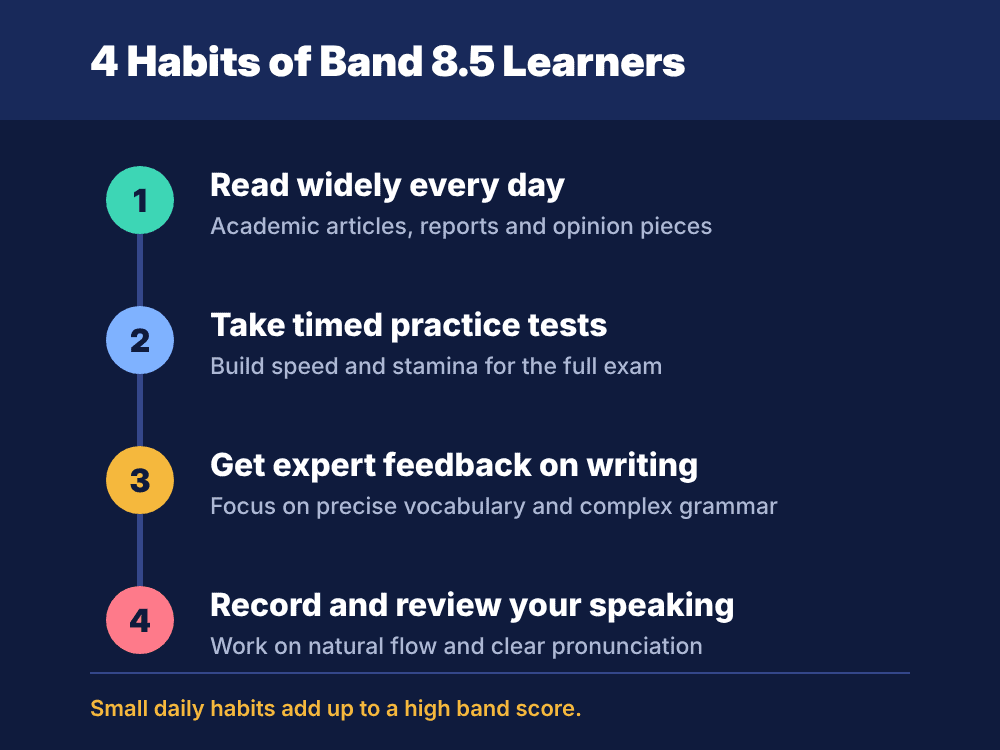
- Listening: Practise with varied accents and natural sources such as podcasts and lectures. Train yourself to catch paraphrases and distractors.
- Reading: Build speed through wide reading, then work on precision, especially True/False/Not Given and Yes/No/Not Given questions.
- Writing: Plan a clear position, develop each idea fully, and aim for precise word choice rather than showy vocabulary. Proofread for small errors.
- Speaking: Record your answers, work on intonation and chunking, and practise giving opinions on abstract topics without long pauses.
IELTS 8.5 is a challenging but achievable goal if you understand how bands are calculated, work on your specific weak criteria, and practise consistently under real test conditions. Use the official band descriptors as your benchmark, get expert feedback on your productive skills, and give yourself enough time. With a structured plan, IELTS 8.5 becomes a realistic target.
Frequently Asked Questions (FAQs)
1. What CEFR level is IELTS 8.5?
IELTS aligns scores of 8.5–9.0 with CEFR level C2, the highest level on the framework. This means an IELTS 8.5 candidate uses English with near-expert accuracy, flexibility and fluency.
2. Do I need 8.5 in every skill to get IELTS 8.5 overall?
No, you do not need 8.5 in every skill. Your overall score is the rounded average of all four skills, so higher scores in other skills can balance one lower band.
3. How long is an IELTS 8.5 certificate valid?
The IELTS certificate itself does not expire. However, most universities and organisations only accept results from the past two years, so you should plan your test date around your applications.
4. How many correct answers do I need for Band 8.5 in Listening?
You usually need about 37–38 correct answers out of 40 for Band 8.5 in Listening. The exact cut-off can vary slightly between test versions, so treat this figure as approximate.
5. Is IELTS 8.5 hard for learners at Band 7.0?
Yes, the jump from 7.0 to 8.5 is challenging because examiners expect near-perfect accuracy. However, learners can reach this band with targeted practice, expert feedback and several months of focused study.
6. Is computer-delivered IELTS easier for scoring 8.5?
No, the computer-delivered test is not easier than the paper-based test. Both formats use the same content, question types, marking criteria and difficulty level, so your choice should depend on comfort.
Keyword:
What foreign language proficiency level is IELTS 8.5?
Is IELTS 8.5 a high score?
Is IELTS 8.5 difficult to achieve in Vietnam?
IELTS 8.5 band score
