
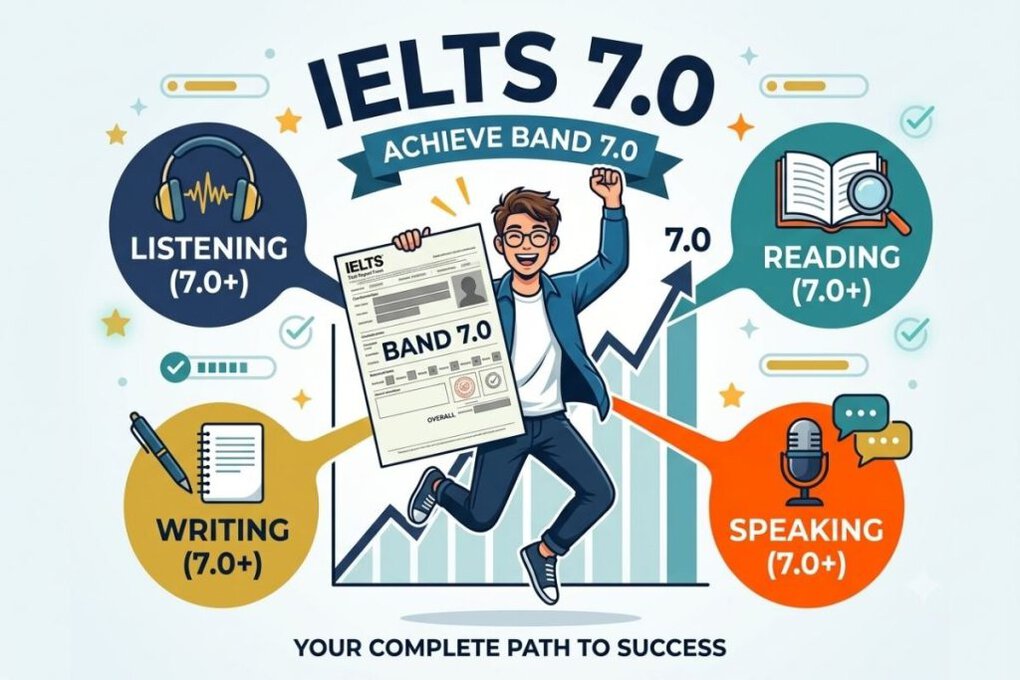
Achieving an IELTS 7.0 represents a solid milestone for English learners, demonstrating effective language command in academic environments and professional settings.
Many candidates often wonder what an IELTS 7.0 is equivalent to across international standards, what advantages certificate provides, and how to structure an effective study plan to reach this band score.
This guide provides a detailed and objective breakdown to help you understand the practical value of an IELTS 7.0 and build a suitable preparation path.
Understanding the IELTS 7.0 band and core criteria
To accurately evaluate the IELTS 7.0 score, learners need to understand how the overall score is calculated and the specific skill requirements defined by international assessment standards.
How the overall 7.0 score is calculated
The overall band score in the IELTS exam is the average of the four component skills: Listening, Reading, Writing, and Speaking. The total average is rounded to the nearest half or whole band score based on a standard 0.25 rounding rule. Specifically, if the average of your four section scores ends in .875, it rounds up to the nearest whole band, which means an average of 6.875 results in an overall 7.0.
For example, if a candidate earns 7.5 in Listening, 7.0 in Reading, 6.5 in Writing, and 6.5 in Speaking, the sum is 27.5. Dividing by 4 yields 6.875, which rounds up to an overall 7.0. This rounding policy provides some flexibility, allowing strong performance in one or two skills to balance slightly lower results in others.
Detailed criteria for each skill (Band descriptors)
According to official assessment guidelines published by the IELTS test partners, a candidate achieving an IELTS 7.0 is classified as a “Good User.” At this band, test-takers demonstrate operational command of the language, though occasional inaccuracies or inappropriate usage may occur in certain situations.
- Listening & Reading: Candidates typically need to answer 30 to 32 out of 40 questions correctly on the Academic module to achieve an IELTS. This accuracy rate shows an ability to grasp main ideas, understand complex arguments, and recognize specific details within dense spoken or written texts.
- Writing: To achieve this band score in Writing Tasks 1 and 2, candidates must address all parts of the prompt and maintain a clear position throughout. Ideas should be presented logically with progressive paragraphing. The response must demonstrate a varied vocabulary with awareness of style and collocation, as well as a range of complex sentence structures with frequent error-free sentences.
- Speaking: In the Speaking section, candidates at this level are expected to speak at length without noticeable effort or loss of coherence. They should use a range of vocabulary flexibly to discuss diverse topics, incorporate idiomatic expressions naturally, and maintain clear pronunciation with appropriate intonation.
What is IELTS equivalent to across common proficiency frameworks?
Comparing test results against recognized language scales helps learners evaluate their standing across different educational systems.

IELTS 7.0 equivalence on the CEFR scale
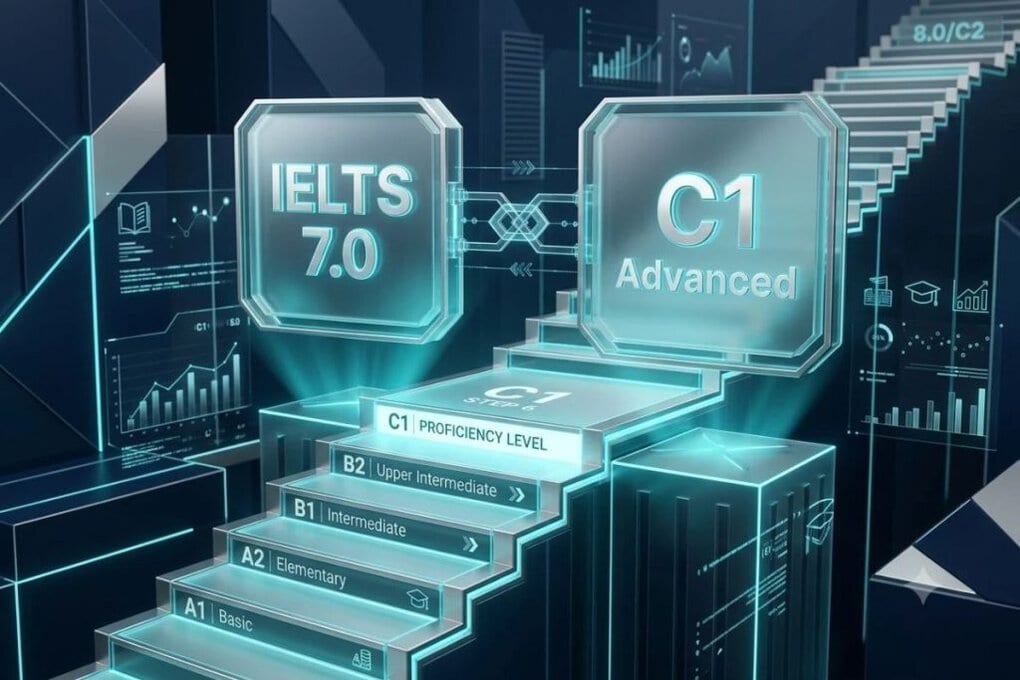
On the Common European Framework of Reference for Languages (CEFR), an IELTS 7.0 corresponds to the C1 (Advanced) level. Learners at C1 level can comprehend demanding, longer texts, express ideas fluently without obvious searching for expressions, and use language flexibly for social, academic, and professional purposes.
Alignment with the VSTEP framework in Vietnam
In relation to the Vietnamese 6-level Foreign Language Proficiency Framework (VSTEP), an IELTS 7.0 aligns with Level 5 (Advanced). This level satisfies and often exceeds the standard foreign language graduation requirements set by higher education institutions in Vietnam.
Score comparison with TOEFL iBT and TOEIC
While each examination measures language proficiency using distinct task formats and scoring criteria, comparative studies offer general equivalencies:
| Framework / Certification | Score Equivalent to IELTS |
| CEFR Framework | C1 (Advanced) |
| VSTEP Framework | Level 5 (Advanced) |
| TOEFL iBT | 94 – 101 points |
| TOEIC (4 Skills) | ~ 785 – 850+ points |
(Note: These conversions serve as general reference points based on comparative research by assessment bodies).
What can you do with an IELTS 7.0 certificate?
Holding an IELTS 7.0 offers practical opportunities across academic admissions, international education, and professional development.
Advantages in university admissions
Many higher education institutions accept international language certificates as part of their admission processes. An IELTS often allows applicants to qualify for converted high scores in the foreign language component during university admission evaluations, strengthening their overall application profile.
Exemption from general English modules
At various universities, students who present a valid IELTS 7.0 certificate may receive exemptions from introductory or intermediate English coursework. This enables students to save time and focus their attention on specialized major subjects or research projects.
Academic study abroad and immigration profiles
An IELTS 7.0 fulfills the language requirements for most undergraduate and postgraduate programs across universities in the United Kingdom, Australia, Canada, the United States, and New Zealand. Additionally, in point-based immigration systems such as Canada’s Express Entry, achieving this score or higher can earn valuable language points toward permanent residency eligibility.
Expanded career opportunities in multinational environments
Demonstrating solid language competence with an IELTS 7.0 serves as a strong credential when applying to multinational companies, foreign enterprise branches, or international development organizations. It reflects a readiness to communicate with international stakeholders, participate in professional discussions, and handle complex workplace documentation.
A structured roadmap from foundation to IELTS 7.0
Reaching an 7.0 requires structured preparation divided into distinct phases matching your current skill level.
Phase 1: Consolidating fundamentals (Band 0 – 3.5)
The focus during this initial stage should be on essential English grammar, expanding core vocabulary around daily topics, and practicing accurate pronunciation using the International Phonetic Alphabet (IPA). Learners should avoid jumping directly into full exam practice and instead build steady listening and reading habits.
Phase 2: Developing skill competence (Band 3.5 – 5.5)
In the second phase, learners begin familiarizing themselves with the IELTS exam format. Time should be balanced across all four skills. Candidates practice organizing basic essays for Writing Task 1 and Task 2, while expanding their ability to speak continuously on familiar topics for Speaking Part 1 and Part 2.
Phase 3: Advanced practice and strategy refinement (Band 5.5 – 7.0+)
This phase focuses on refining test-taking strategies under timed conditions. Reading skills like skimming and scanning should be honed alongside listening for detailed information. For Writing and Speaking, receiving constructive feedback from experienced instructors or academic mentors is vital to identifying persistent errors, improving paragraph cohesion, and adopting academic vocabulary.
In summary, achieving an IELTS 7.0 provides clear advantages ranging from university admissions and academic credit exemptions to study-abroad opportunities and career progression. Understanding what this score is equivalent to and identifying how to use it effectively helps you set realistic goals and remain motivated throughout your preparation journey. By assessing your current standing and adhering to a systematic study strategy, reaching this target becomes a structured and achievable process.
Frequently asked questions about IELTS 7.0
How long does it take to reach 7.0 from a basic level?
The preparation timeframe depends on initial language proficiency and weekly study hours. Educational research indicates that moving from a basic level to an IELTS 7.0 typically requires between 600 and 800 hours of guided instruction and deliberate practice, which often translates to 8 to 14 months of regular study.
Is self-study feasible to achieve an IELTS 7.0?
Self-study can be effective for building receptive skills (Reading and Listening) using reliable study materials. However, for productive skills (Writing and Speaking), having an experienced mentor evaluate your work helps pinpoint subtle grammatical issues, style inconsistencies, and task-response gaps.
How long is an IELTS 7.0 test report form valid?
An IELTS 7.0 certificate remains valid for two years from the test date. Candidates should plan their examination schedule so their test report remains valid during university application or visa processing periods.
Key words:
- 7 in IELTS means
- IELTS 7.0 writing sample
- IELTS 7.0 to toeic
- IELTS 7.0 meaning
- IELTS 7.0 level
- IELTS 7.0 equivalent
- IELTS 7.0 certificate
- IELTS band 7 meaning
