
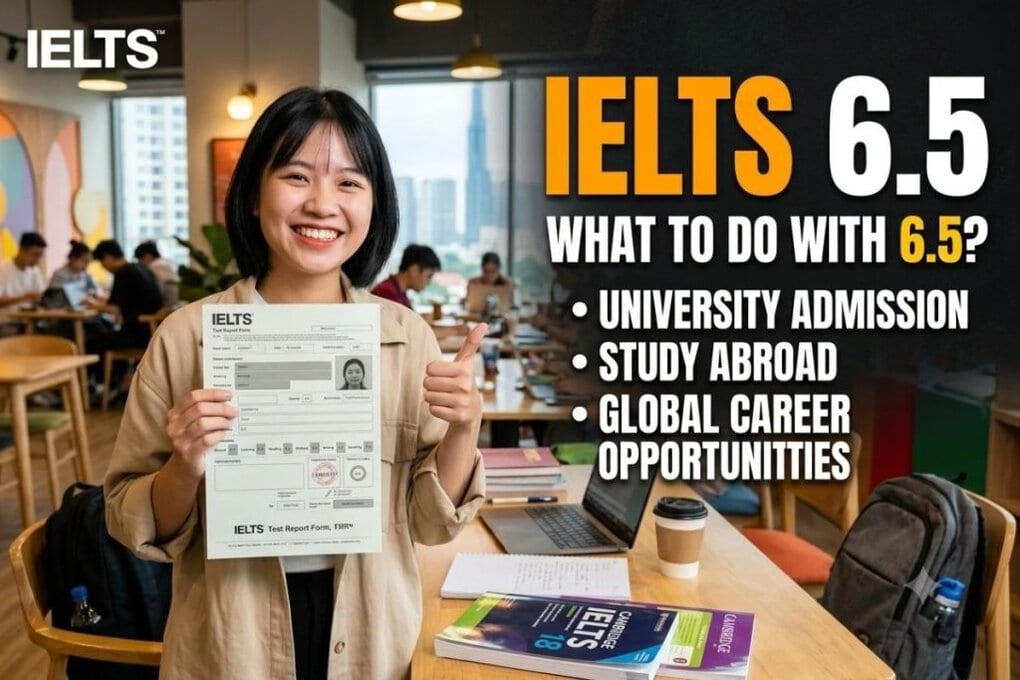
IELTS 6.5 is a significant milestone that many English learners aim for. At this score, you can demonstrate the ability to use the language flexibly in various situations, from daily communication to academic environments.
However, many learners still wonder how this score reflects actual proficiency and specifically what an IELTS 6.5 can do in the context of current study and career development. The following article provides a comprehensive overview, based on accurate language assessment standards from reputable organizations.
How does an IELTS 6.5 score reflect English proficiency?
To understand the value of this certificate, we need to consider how organizing bodies (such as the British Council, IDP, and Cambridge Assessment English) evaluate the competence of candidates reaching the 6.5 mark.
Competence assessment criteria at 6.5
According to the standard grading scale, a person achieving IELTS 6.5 is classified in the group of “Competent Users”. Specifically, you have the ability to use the language effectively in familiar situations. Although you may occasionally make a few minor errors in accuracy or not fully understand complex contexts, you generally control vocabulary and sentence structures well and can understand detailed reasoning.
What is IELTS 6.5 equivalent to on the European framework?
Another common question is what IELTS 6.5 is equivalent to according to the Common European Framework of Reference for Languages (CEFR). Based on the official Cambridge conversion table, an Overall 6.5 score falls within the B2 proficiency band.
The B2 level (Upper Intermediate) indicates that learners can:
- Understand the main ideas of complex texts on both concrete and abstract topics, including technical discussions in their field of specialization.
- Communicate fluently and naturally, creating comfort during interactions with native speakers.
- Produce clear, detailed texts on a wide range of subjects and explain a viewpoint on a topical issue, giving the advantages and disadvantages of various options.
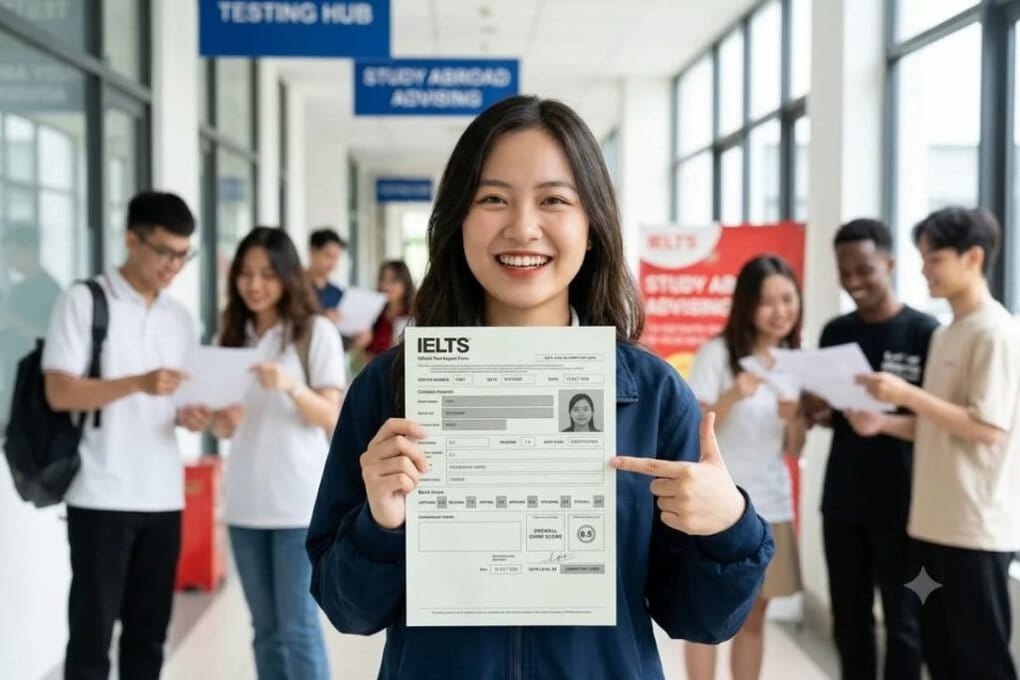
What can you do with an IELTS 6.5 certificate?
Owning an IELTS 6.5 certificate brings many practical advantages, opening up various opportunities for different groups. Below are specific benefits you can receive.
For high school students: Expanding university admission opportunities
According to the high school graduation exam regulations of the Ministry of Education and Training in recent years, students with an IELTS certificate of 4.0 or higher are eligible for exemption from the foreign language exam.
With a score of 6.5, students often have this converted to a score of 10 in English for graduation purposes. Additionally, many reputable universities in Vietnam have admission methods that combine international language certificates. An IELTS 6.5 is usually a sufficient condition for a high converted score, helping candidates increase their chances of being admitted to their desired majors.
For university students: Optimizing time and costs
If you are a university student, obtaining an IELTS 6.5 certificate early on offers significant convenience. The majority of universities require students to meet a foreign language exit standard to graduate.
This requirement generally ranges from 5.5 to 6.5 depending on the major. Furthermore, by submitting this certificate during the early years of university, students can often be exempted from basic English credits. This helps save a considerable amount of tuition fees and provides extra time to focus on specialized subjects or participate in extracurricular activities.
For study abroad and immigration purposes: An international passport
This is a common entry requirement for Bachelor’s and Master’s degrees in many English-speaking countries such as the UK, Australia, the US, Canada, and New Zealand. This score ensures you have the capacity to understand lectures, read specialized materials, and complete theses in English. However, it should be noted that certain specialized fields like Medicine, Law, or Education might require a higher score (from 7.0 upwards). In the field of immigration, IELTS 6.5 also helps applicants gain extra points in skilled worker visa applications, making their profiles more competitive.
For working professionals: Elevating your career
In a globalized working environment, multinational corporations frequently prioritize candidates with strong foreign language communication skills. An IELTS 6.5 score is clear evidence of the ability to work in an international setting. Drafting emails, participating in online meetings, or negotiating with foreign partners becomes easier, thereby opening up clear promotion paths with attractive remuneration packages.
Is achieving IELTS 6.5 difficult and how much time is needed?
Conquering the IELTS 6.5 goal is a manageable task, requiring persistence and a scientific learning method. The difficulty and required time depend primarily on each individual’s starting point.
- From zero to IELTS 6.5: A beginner in English generally needs about 8 to 12 months of continuous study, with an intensity of about 2-3 hours per day. This process requires learners to rebuild their entire grammar, vocabulary, and basic pronunciation systems before familiarizing themselves with the test.
- From a basic level (around 4.0 – 5.0) to 6.5: Once a certain foundation is established, it takes about 3 to 6 months to get used to the test structure, practice test-taking strategies, and improve accuracy in the Writing and Speaking sections.
The main challenge of this score often lies in the two active skills: Writing and Speaking. To achieve 6.5, you need to use diverse vocabulary related to various topics, complex grammar structures, and express ideas coherently with strong linking.

A scientific and effective IELTS 6.5 study roadmap
To achieve the target, learners should divide the preparation process into specific phases to clearly track progress.
Phase 1: Building the foundation (Target 3.0 – 4.0): In this phase, focus should be directed towards strengthening three core elements: Vocabulary, Grammar, and Pronunciation. You can refer to basic materials such as Grammar for IELTS or English Vocabulary in Use. Start forming the habit of listening to English through short conversations and daily topic podcasts to let your ears get used to natural intonation.
Phase 2: Approaching the test structure (Target 4.0 – 5.5): When the foundation is solid, the next step is to thoroughly understand the format of all 4 skills in the IELTS test.
- Listening & Reading: Start practicing specific question types (Multiple Choice, True/False/Not Given, Matching Headings, etc.).
- Speaking & Writing: Get familiar with Part 1 questions in Speaking and how to analyze charts (Task 1) or write basic argumentative essays (Task 2) in Writing. Focus on answering directly and structuring paragraphs clearly.
Phase 3: Intensive test practice (Target 5.5 – 6.5): This is the final sprint phase. Focus on solving standard practice tests like Cambridge IELTS (recently published editions) under real-time pressure. After each test, analyzing mistakes is important to gain experience. For Writing and Speaking skills, learners should seek teachers or language professionals to have their work graded and receive detailed feedback, thereby correcting expression errors and improving scores.
Through the analysis above, we hope you have a clear perspective to answer what an IELTS 6.5 can do as well as understand its equivalent level on the CEFR scale.
This is an ideal score, sufficient to equip you with valuable opportunities in both your academic path and career. To realize this goal, build a serious study plan, persistently follow the established roadmap, and regularly evaluate your preparation methods.
Frequently asked questions about IELTS 6.5
How long is an IELTS 6.5 certificate valid for?
Similar to all other scores of the IELTS exam, this certificate is valid for 2 years from the test date printed on the Test Report Form. After this period, educational institutions or employers will usually require you to retake the test to accurately assess your current language proficiency.
Is it possible to get a study abroad scholarship with IELTS 6.5?
Yes. Many universities worldwide offer partial or full scholarships for international students achieving this score, often combined with a strong academic GPA and notable extracurricular activities.
Should I self-study or take intensive courses?
Both methods have their own advantages. Self-studying helps save costs but requires high discipline and good independent research skills. Conversely, studying at professional prep classes provides you with a clear roadmap, an environment to practice reflexes, and specifically, error correction support from professionals.
Key words:
- IELTS 6.5 test
- IELTS 6.5 level
- IELTS 6.5 equivalent
- IELTS 6.0
- IELTS 6.5 cefr
- IELTS 6.5 to pte
- IELTS levels
- IELTS 6.5 toefl
