

Family is a familiar topic that frequently appears in daily English conversations as well as language proficiency exams. Having a strong grasp of family vocabulary will help you feel more confident when communicating and expressing your thoughts fluently. This article provides a comprehensive system of family-related words, ranging from basic terms used to describe relatives to advanced academic collocations, along with effective methods for retention.
Basic family vocabulary for daily communication
To begin, we need to familiarize ourselves with vocabulary indicating family members. This group of words is categorized into different generations and family structures, making it easier for you to visualize and apply.
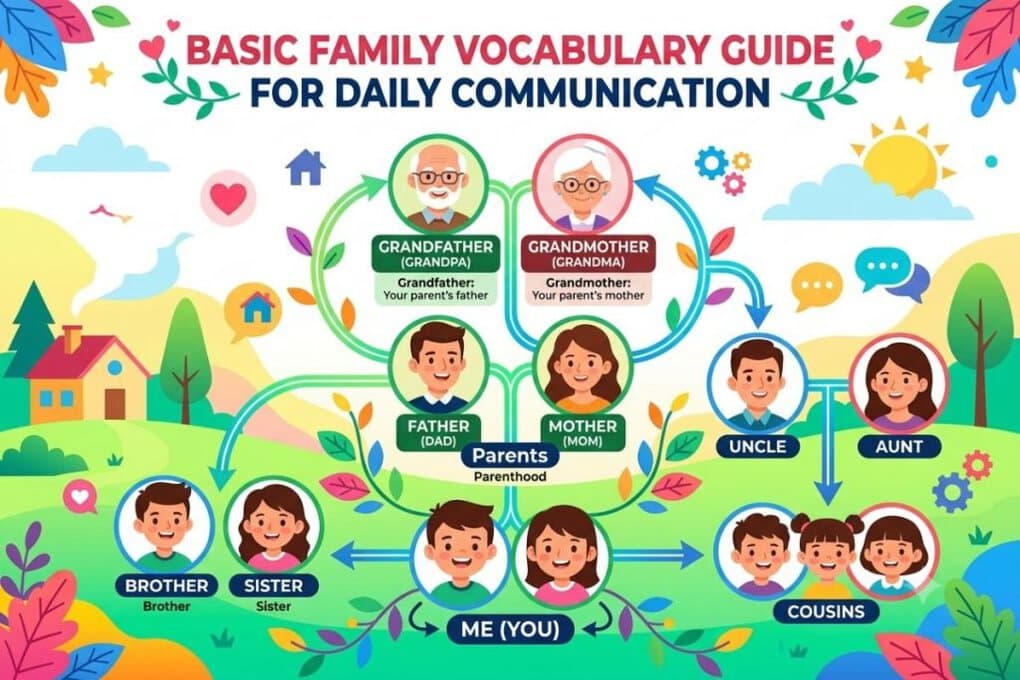
Nuclear family
A nuclear family typically consists of two generations – parents and children – living together under one roof. This is the core family vocabulary group you need to remember.
| Vocabulary | Pronunciation (IPA) | Meaning | Example |
| Parents | /ˈpeə.rənts/ | Bố mẹ | My parents are very supportive of my career choice. |
| Spouse | /spaʊs/ | Vợ hoặc chồng | Employees can bring their spouses to the company party. |
| Husband | /ˈhʌz.bənd/ | Chồng | Her husband works as a software engineer. |
| Wife | /waɪf/ | Vợ | He bought a meaningful gift for his wife. |
| Sibling | /ˈsɪb.lɪŋ/ | Anh chị em ruột | Do you have any siblings? |
| Offspring | /ˈɒf.sprɪŋ/ | Con cái (nói chung) | They are hoping for healthy offspring. |
| Only child | /ˌəʊn.li ˈtʃaɪld/ | Con một | Being an only child has its own advantages. |
Extended family & relatives
When expanding your circle, you will need to use vocabulary for relatives. These words often appear when introducing your roots or during family holiday gatherings.
| Vocabulary | Pronunciation (IPA) | Meaning |
| Grandparents | /ˈɡræn.peə.rənts/ | Ông bà |
| Ancestors | /ˈæn.ses.tərz/ | Tổ tiên |
| Uncle | /ˈʌŋ.kəl/ | Chú, bác trai, cậu, dượng |
| Aunt | /ɑːnt/ | Cô, dì, bác gái, mợ |
| Cousin | /ˈkʌz.ən/ | Anh chị em họ |
| Nephew | /ˈnef.juː/ | Cháu trai (con của anh/chị/em) |
| Niece | /niːs/ | Cháu gái (con của anh/chị/em) |
| Father-in-law | /ˈfɑː.ðə.rɪn.lɔː/ | Bố chồng/bố vợ |
| Mother-in-law | /ˈmʌð.ə.rɪn.lɔː/ | Mẹ chồng/mẹ vợ |
Read more:
Modern family structures
Modern society features a diverse range of family structures. Understanding these terms not only expands your family vocabulary but also demonstrates your cultural and social awareness.
- Single-parent family (/ˌsɪŋ.ɡəl ˈpeə.rənt ˈfæm.əl.i/): A family where only one parent lives with and raises the children.
- Blended family / Stepfamily (/ˈblen.dɪd ˈfæm.əl.i/): A family consisting of a couple and their children from this and all previous relationships. Related terms include: stepmother, stepfather, half-brother (a brother who shares only one parent with you).
- Adoptive family (/əˈdɒp.tɪv ˈfæm.əl.i/): A family that has legally adopted a child. This is distinct from a foster family, which provides temporary care.
IELTS family vocabulary – Upgrading your academic lexicon
In exams like IELTS (especially Speaking Part 1, Part 3, and Writing Task 2), using single, simple words often does not yield a high score. Instead, you need to utilize ielts family vocabulary, which includes natural collocations, idiomatic expressions, and in-depth descriptive adjectives.

Adjectives describing family dynamics and relationships
- Close-knit (/ˌkləʊsˈnɪt/): Tied together by strong relationships and common interests. (Example: I am fortunate to grow up in a close-knit family where everyone supports each other.)
- Harmonious (/hɑːˈməʊ.ni.əs/): Friendly and peaceful.
- Supportive (/səˈpɔː.tɪv/): Providing encouragement or emotional help.
- Overprotective (/ˌəʊ.və.prəˈtek.tɪv/): Wishing to protect someone, especially a child, too much. (Example: Some parents are overprotective, which might hinder their children’s independence.)
- Dysfunctional (/dɪsˈfʌŋk.ʃən.əl/): Not behaving or working normally, often used to describe families with a lot of conflict.
Additionally, parenting styles are a frequent topic:
- Authoritarian: Demanding strict obedience to authority.
- Authoritative: Strict but understanding and willing to explain rules.
- Permissive: Giving people a lot of freedom, placing few rules.
Verbs & collocations
Effectively applying phrasal verbs and collocations from the ielts family vocabulary group makes your sentences sound more natural.
- Bring up / Raise: To care for a child until they are an adult. (She was brought up by her grandmother.)
- Look up to someone: To admire and respect someone. (I always look up to my father for his resilience and wisdom.)
- Take after someone: To be similar to an older member of your family in appearance or character. (Everyone says I take after my mother in terms of personality.)
- Instill values: To impart moral principles gradually. (Parents play a crucial role in instilling moral values in their children.)
- Bridge the generation gap: To reduce the differences in attitudes or understanding between older and younger people. (Open communication can help bridge the generation gap between parents and adolescents.)
Family-related idioms
- Blood is thicker than water: Family relationships and loyalties are the strongest and most important ones.
- Run in the family: To be a common feature or trait within a family. (Artistic talent seems to run in my family.)
- Like father, like son: Fathers and sons resemble each other, and sons tend to do what their fathers did before them.
- Spitting image: To look exactly like someone else. (He is the spitting image of his grandfather.)
Practical application of my family vocabulary
When asked to “Tell me about your family,” you can combine the words you have learned to create an impressive spoken or written response. Practicing the my family vocabulary group using templates helps improve your language reflexes.
Basic introduction structures:
- I come from a family of [number]…
- I am the [oldest/middle/youngest/only] child…
- My family consists of…
Personality description patterns:
- My mother is a caring person who always puts her family first.
- My father is the breadwinner, providing for our needs.
Sample reference paragraph:
“I come from a relatively small nuclear family of four: my parents, my younger sister, and me. We are a very close-knit family. My father is the primary breadwinner, while my mother takes care of the household, though she also works part-time. I often think I take after my mother, as we are both quite organized and patient. Despite our busy schedules, we always try to have dinner together to bridge any generation gap and share our daily experiences.”
Learning through a family vocabulary game
Learning vocabulary through a family vocabulary game is a practical solution to reduce boredom and enhance retention through context. You can apply the following methods for individual study or group sessions.
Family tree mapping
This is a visual game. Draw a family tree of your own family on paper, then fill in the English name for each relationship next to your relatives’ names. Associating vocabulary with real people helps the brain store information more deeply.
“Who am I?” guessing game
This game trains logical thinking in English. One person provides a description, and the other must guess the corresponding vocabulary word.
- Riddle 1: I am your mother’s brother. Who am I? (Answer: Uncle)
- Riddle 2: I am your father’s mother. Who am I? (Answer: Grandmother)
- Riddle 3: I am the daughter of your uncle. Who am I? (Answer: Cousin)
Digital game applications
You can take advantage of online learning platforms to find or create a family vocabulary game. Apps like Quizlet, Kahoot!, or Wordwall offer various formats such as flashcards, quick quizzes, and word-matching games, making the vocabulary review process much more engaging.
Practice exercises
To reinforce all the family vocabulary you have learned, try completing the exercises below.
Exercise 1: Fill in the blanks with the appropriate words (nuclear family, upbringing, generation gap, inherited, siblings)
- My grandparents complain that there is a large __________ between them and teenagers today.
- She __________ her beautiful blue eyes from her mother.
- Growing up with three __________, the house was always noisy but fun.
- A traditional __________ usually consists of a mother, a father, and their children.
- His strict __________ heavily influenced his personality as an adult.
Exercise 2: Choose the correct answer (Collocations & Idioms)
- I always __________ my older brother; he is a great role model. A. look up to B. look down on C. take after
- The ability to sing beautifully seems to __________ in their family. A. walk B. run C. stay
- Since her parents passed away, she was __________ by her aunt. A. grown up B. taken after C. brought up
Answer Key:
- Exercise 1: 1 – generation gap, 2 – inherited, 3 – siblings, 4 – nuclear family, 5 – upbringing.
- Exercise 2: 1 – A (look up to), 2 – B (run), 3 – C (brought up).
The topic of family in English is incredibly rich and deeply connected to everyone’s life. Instead of memorizing isolated words, applying them to specific contexts, learning through collocations, and practicing with a family vocabulary game will bring more sustainable results.
Whether you are aiming to improve your daily communication or enhance your ielts family vocabulary, consistent practice is essential. Try writing a short journal entry using my family vocabulary to introduce your loved ones, which will help turn this knowledge into your natural language reflex. Feel free to share a brief description of your family in the comments below!
Frequently asked questions
1. How can I remember academic ielts family vocabulary without forgetting it?
An effective learning method is to put vocabulary into your own personal context rather than learning words in isolation by rote. For example, when learning the phrase “generation gap”, create a sentence directly related to your family: “There is a slight generation gap between my parents and me regarding career choices.” Connecting words to personal emotions helps the brain store information longer. Additionally, you should use spaced repetition via flashcard apps.
2. In the IELTS exam, where does the family topic usually appear?
This topic is very common and can appear in all three parts of the Speaking test. In Part 1, the examiner often asks basic questions for you to apply my family vocabulary (e.g., describing your siblings, who you are close to). In Part 3 or Writing Task 2, the questions will be more macro-level, requiring you to discuss changing family structures, the role of parents in education, or the differences between generations.
3. What family vocabulary game can I use to study with children at home?
For children or beginners, the “Family Tree” game and visual flashcards are highly interactive and effective. You can print pictures of family members, stick them on a board, and ask the child to attach the corresponding English vocabulary card. In addition, the “Who am I?” trivia game helps learners react quickly to relative vocabulary (uncle, aunt, cousin).
Key words:
- Family vocabulary worksheet
- Family vocabulary ielts
- Family vocabulary ielts pdf
- Family vocabulary flashcards
- Family vocabulary exercises
- Family vocabulary quiz
- Family vocabulary words
- Family vocabulary games
