

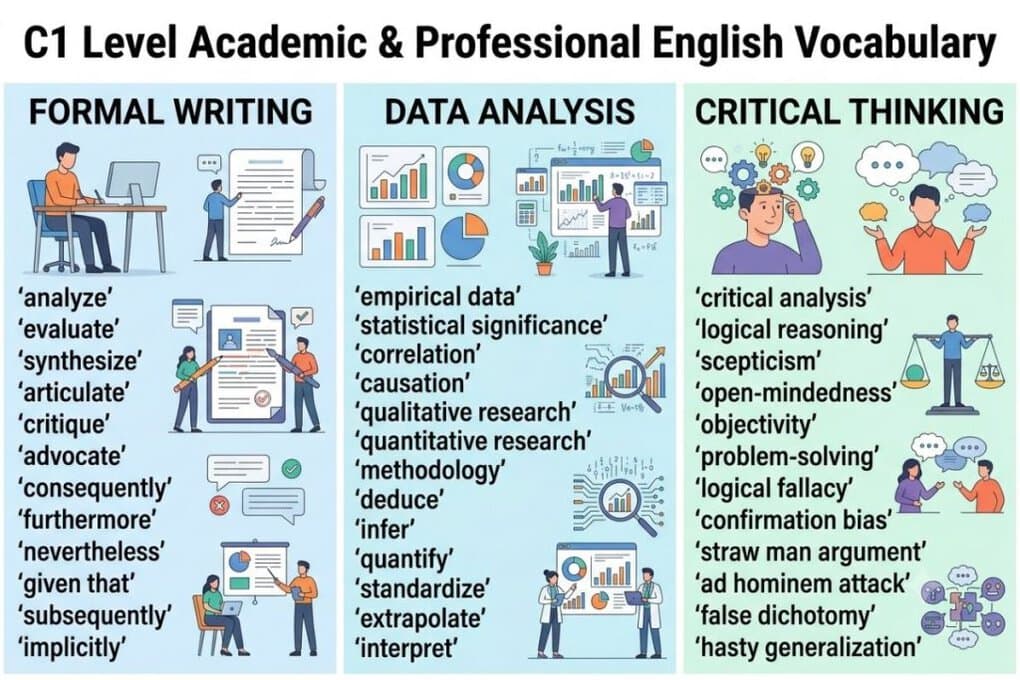
Developing a solid c1 vocabulary allows you to articulate complex thoughts fluently, understand dense academic texts, and communicate effectively in professional environments. This guide provides a curated vocabulary overview grouped by topic, alongside practical methods to help you retain and apply these terms naturally.
Why is expanding your c1 vocabulary important?
The C1 (Advanced) level on the Common European Framework of Reference for Languages (CEFR) indicates that a learner can understand a wide range of demanding, longer texts and recognize implicit meaning.
Advantages in academic examinations
In standardized tests such as IELTS, Lexical Resource accounts for 25% of your total score in both Speaking and Writing. Achieving a band score of 7.0 or above generally requires using less common lexical items with awareness of style and collocation. A thoughtfully prepared c1 word list ielts resource helps you move beyond basic vocabulary, allowing you to express complex ideas with greater precision.
Enhanced communication in professional settings
In professional environments, particularly within multinational organizations, using english c1 word can make your writing and speaking more concise and persuasive. Instead of using lengthy explanations, choosing the right C1 term can convey subtle nuances efficiently during presentations, email exchanges, and report writing.
Read more:
Key differences between B2 and C1 vocabulary
The transition from B2 to C1 is less about learning obscure words and more about achieving precision and subtle nuance in context.
At the B2 level, learners possess enough language to converse comfortably on most familiar topics. At the C1 level, however, vocabulary becomes more specialized and sophisticated, frequently appearing in academic journals, economic news, and formal literary texts.
For example, to describe something of great importance, a B2 learner might repeatedly rely on important or essential. A user with C1 level proficiency might select crucial, indispensable, or pivotal, depending on the exact context.

Structured c1 vocabulary list by topic
To assist your learning, the following c1 word list is categorized by common academic and everyday topics. These terms are drawn from authoritative sources (such as the Cambridge and Oxford dictionaries) to reflect real-world usage.
Topic 1: Work & Business
| Vocabulary (C1 Vocabulary) | Part of Speech | Phonetic | Definition | Example Sentence |
| Lucrative | Adj | /ˈluː.krə.tɪv/ | Producing a great deal of profit | The merger proved to be a highly lucrative venture for both companies. |
| Delegate | Verb | /ˈdel.ɪ.ɡeɪt/ | Entrust a task or responsibility to another person | A capable manager knows how to delegate tasks effectively to their team. |
| Mitigate | Verb | /ˈmɪt.ɪ.ɡeɪt/ | Make something less severe or painful | The company proposed several measures to mitigate the environmental impact. |
| Redundant | Adj | /rɪˈdʌn.dənt/ | No longer needed; laid off from a job | Many employees were made redundant due to the economic downturn. |
| Entrepreneurial | Adj | /ˌɒn.trə.prəˈnɜː.ri.əl/ | Characterized by financial risk-taking for profit | She possesses a strong entrepreneurial spirit, constantly seeking new opportunities. |
Topic 2: Environment & Society
| Vocabulary (C1 Vocabulary) | Part of Speech | Phonetic | Definition | Example Sentence |
| Detrimental | Adj | /ˌdet.rɪˈmen.təl/ | Tending to cause harm | Prolonged exposure to sunlight can have a detrimental effect on skin health. |
| Unprecedented | Adj | /ʌnˈpres.ɪ.den.tɪd/ | Never done or known before | The region is facing an unprecedented level of rainfall this season. |
| Marginalize | Verb | /ˈmɑː.dʒɪ.nə.laɪz/ | Treat a person or group as insignificant | Policy makers must ensure that vulnerable communities are not marginalized. |
| Sustainable | Adj | /səˈsteɪ.nə.bəl/ | Able to be maintained over time | The government is promoting sustainable development initiatives across cities. |
| Alleviate | Verb | /əˈliː.vi.eɪt/ | Make suffering or a problem less severe | The new community initiatives are designed to alleviate poverty in regional areas. |
Topic 3: Education & Technology
| Vocabulary (C1 Vocabulary) | Part of Speech | Phonetic | Definition | Example Sentence |
| Pedagogical | Adj | /ˌped.əˈɡɒdʒ.ɪ.kəl/ | Relating to teaching or education methods | The institution is adopting new pedagogical approaches to foster engagement. |
| Obsolete | Adj | /ˈɒb.səl.iːt/ | No longer produced or used; out of date | Rapid technological advancements have rendered older hardware obsolete. |
| Paradigm | Noun | /ˈpær.ə.daɪm/ | A typical pattern or conceptual framework | The emergence of new tools created a paradigm shift in digital communication. |
| Cognitive | Adj | /ˈkɒɡ.nə.tɪv/ | Relating to mental processes of perception | Engaging in complex puzzles can support healthy cognitive development. |
| Scrutinize | Verb | /ˈskruː.tɪ.naɪz/ | Examine or inspect closely and thoroughly | The committee plans to scrutinize the project proposal before voting. |
Topic 4: Health & Lifestyle
| Vocabulary (C1 Vocabulary) | Part of Speech | Phonetic | Definition | Example Sentence |
| Sedentary | Adj | /ˈsed.ən.tər.i/ | Involving little physical activity; seated | Maintaining a sedentary lifestyle may increase the risk of chronic health conditions. |
| Susceptible | Adj | /səˈsep.tə.bəl/ | Likely to be influenced or harmed | Individuals with weakened immunity are more susceptible to seasonal illness. |
| Rejuvenate | Verb | /rɪˈdʒuː.vən.eɪt/ | Make someone look or feel vital again | Taking a short rest can help rejuvenate your energy levels during work. |
| Proponent | Noun | /prəˈpəʊ.nənt/ | A person who advocates an idea or project | She is a clear proponent of renewable energy adoption in urban planning. |
| Resilient | Adj | /rɪˈzɪl.i.ənt/ | Able to recover quickly from difficulty | Communities often prove remarkably resilient in the face of natural challenges. |
Expanding english c1 through phrasal verbs and collocations
When learning english c1 vocabulary, focusing solely on single words is rarely sufficient. Advanced proficiency is often demonstrated through natural word partnerships (collocations) and idiomatic expressions (phrasal verbs). In any comprehensive c1 vocabulary list ielts context, mastering these patterns can noticeably improve naturalness in both Speaking and Writing.
High-frequency C1 vocabulary phrasal verbs
- Boil down to: To be summarized as the main point or cause. (Example: The issue ultimately boils down to a lack of clear communication.)
- Factor in: To include a particular fact or situation when making a plan. (Example: We should factor in potential delays when setting the project timeline.)
- Phase out: To gradually stop using or providing something. (Example: Many cities plan to phase out single-use plastics over the coming years.)
Advanced collocations
- Reap the benefits: To gain positive results from past efforts.
- Strike a balance: To find a fair compromise between two opposing aspects.
- Bear a resemblance to: To look like or be similar to another person or object.
Using accurate collocations ensures that your phrasing sounds natural and authentic to fluent speakers.
Effective strategies for retaining c1 vocabulary
Memorizing long lists of complex words without context can lead to quick forgetting. Adopting a structured learning framework helps make the acquisition of your c1 vocabulary list much more manageable.
Contextual learning
The most reliable way to acquire advanced vocabulary is by encountering words in meaningful contexts. Rather than studying isolated word lists, read reputable news outlets (such as The Economist or The Guardian) and listen to academic podcasts or TED Talks. This exposes you to how native speakers use english c1 vocabulary in real-world discussions.
Spaced repetition systems (SRS)
Human memory naturally fades over time without review. Using digital flashcard tools like Anki or Quizlet allows you to leverage Spaced Repetition algorithms. Creating personal digital flashcards – complete with the word, phonetic spelling, definition, and a customized sample sentence—helps transfer new terms from short-term memory to long-term storage.
Active production
To convert passive knowledge into active vocabulary, you must practice producing the language. Whenever you learn new entries from a c1 vocabulary list ielts, draft short paragraphs or record yourself speaking using those specific terms. Constructing your own sentences deepens your understanding of grammar and subtle connotations.
Reliable resources for C1 vocabulary reference
Relying on authoritative language materials ensures that you learn accurate definitions and appropriate usage:
- Learner’s Dictionaries: Cambridge Dictionary and Oxford Learner’s Dictionaries provide CEFR level labels (such as B2, C1, C2) alongside clear definitions and authentic sentence examples.
- Advanced Coursebooks: Resources like English Vocabulary in Use: Advanced or Vocabulary for IELTS Advanced offer organized units with contextual exercises designed for higher-level learners.
Mastering c1 vocabulary is a gradual process requiring patient daily accumulation through reading, listening, and active practice. By working through a structured c1 vocabulary list and applying appropriate learning strategies, you can build a versatile linguistic foundation to support your academic and professional growth.
Frequently asked questions
1. How long does it take to learn a comprehensive c1 vocabulary list?
The timeline varies based on your current level, study habits, and daily exposure to English. Rather than attempting to memorize large quantities quickly, aiming for 3 to 5 new words per day with consistent review often yields more sustainable progress over time.
2. Should you use complex english c1 vocabulary in IELTS Speaking Part 1?
IELTS Speaking Part 1 covers familiar everyday topics like your home, work, or hobbies. Overusing formal or heavy academic terms here can make your speech sound unnatural. It is generally better to maintain a conversational style in Part 1 and introduce more nuanced c1 vocabulary organically in Part 3.
How can you verify whether a word is B2 or C1 level?
Checking online resources such as the Cambridge Dictionary or Oxford Learner’s Dictionaries is a straightforward method. These tools display clear CEFR markers (e.g., [B2] or [C1]) next to entries and specific definitions.
Key words:
- C1 vocabulary list pdf
- C1 vocabulary list
- C1 vocabulary pdf
- C1 vocabulary quiz
- C1 vocabulary exercises
- C1 vocabulary words
- C1 vocabulary worksheets
- C1 vocabulary worksheet pdf
