
An IELTS 7.5 is considered a high score on the IELTS 9.0 scale, demonstrating a strong ability to use English for academic, professional, and everyday communication purposes. According to the IELTS band score descriptors, Band 7 is described as a “Good User,” while Band 8 is a “Very Good User.” Therefore, IELTS 7.5 falls between these two levels and is generally considered an outstanding result.
For many learners, achieving IELTS 7.5 is not simply about reaching a particular score. It also demonstrates the ability to use English with a relatively high degree of flexibility. At this level, test takers can generally understand complex texts, express ideas clearly, and handle most communication situations in English.
However, whether IELTS 7.5 is considered a high score depends on each individual’s goals. If the score is intended for university admission, studying abroad, English course exemptions, or employment requirements, learners should check the specific requirements of the relevant university, organization, or employer rather than relying solely on the band score.
What Does a Certificate Mean?
An IELTS 7.5 reflects the result of either the IELTS Academic or IELTS General Training test, depending on the type of test taken. IELTS assesses four skills: Listening, Reading, Writing, and Speaking, with each skill scored on a band scale from 0 to 9.
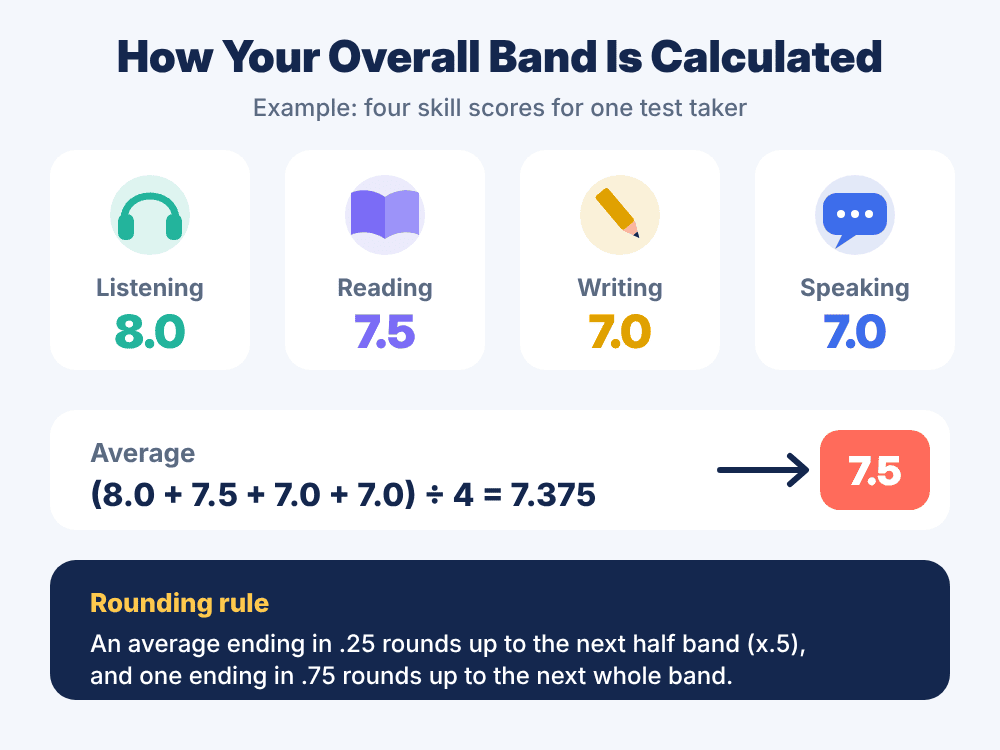
The Overall Band Score is calculated based on the average score across the four skills and rounded according to IELTS scoring rules. Therefore, test takers do not necessarily need to achieve 7.5 in all four skills to obtain an Overall Band Score of 7.5.
For example, a test taker who scores 8.0 in Listening, 8.0 in Reading, 7.0 in Writing, and 7.0 in Speaking has an average score of 7.5. This demonstrates that IELTS 7.5 is an overall result based on all four skills rather than a score determined solely by performance in Reading or Listening.
In terms of language proficiency, IELTS 7.5 is generally associated with the C1 range of the Common European Framework of Reference for Languages (CEFR). However, IELTS and CEFR are different assessment systems, and there is no absolute one-to-one conversion between individual IELTS bands and CEFR levels.
Is IELTS 7.5 High When Considering Each Skill?
To achieve the score, learners need to develop all four skills relatively evenly. Each skill is assessed according to its own criteria, so the appropriate learning and practice methods also differ.
- Listening: Learners need to be able to follow relatively long conversations and talks while identifying specific information, main ideas, and different ways of expressing information.
- Reading: At this level, learners need to handle texts containing academic vocabulary, complex sentence structures, and information presented in different ways. Paraphrasing skills are particularly important because answers often do not repeat the exact wording used in the passage.
- Writing: This is often the skill that requires the most time to improve. Test takers must address all parts of the task, develop ideas clearly, use appropriate vocabulary, and maintain good grammatical control. To achieve IELTS 7.5, writing requires more than a wide vocabulary; words must be used accurately and appropriately while maintaining coherence and cohesion.
- Speaking: Test takers need to respond naturally, develop their answers, and demonstrate a range of appropriate grammatical structures and vocabulary. Clear pronunciation and the ability to maintain fluency also play important roles.
Where Should You Start When Studying for IELTS 7.5?
An effective IELTS 7.5 study roadmap should be based on the learner’s starting level rather than following a fixed timeframe for everyone. Someone with a strong English foundation will need a different study plan from someone who is just beginning to learn English.
Stage 1: Assess Your Current Level
First, take a test covering all four skills to identify your strengths and weaknesses. If your current level is around IELTS 5.0, your immediate goal may be to strengthen your grammar, vocabulary, and test-taking skills before working toward IELTS 7.5.
Stage 2: Build a Strong Foundation
Learners should review essential grammar areas such as tenses, conditional sentences, relative clauses, passive voice, linking words, and complex sentence structures. At the same time, build topic-based vocabulary around common IELTS subjects rather than memorizing isolated word lists.
Stage 3: Practise Skills Based on the Scoring Criteria
Once the foundation is stable, move on to practising each skill individually. For Writing and Speaking, comparing your performance against the official assessment criteria or receiving feedback from an experienced teacher can help identify errors that are difficult to recognize on your own.
Stage 4: Practise Full Tests and Manage Your Time
During the final stage of your IELTS 7.5 study roadmap, complete practice tests under conditions that closely resemble the actual test environment. After each practice session, do more than simply count the number of correct answers. Analyze the reasons for your mistakes, especially in Reading and Listening.
For Writing and Speaking, keep a record of recurring issues involving vocabulary, grammar, idea development, and pronunciation so that you can track your progress from week to week.
What Can an IELTS 7.5 Certificate Be Used For?
Many people search for an IELTS 7.5 certificate with the goal of studying abroad, applying to universities, meeting English-language requirements, or strengthening their professional profile. However, IELTS is technically a test result or language proficiency certificate rather than an academic degree.
The value of an IELTS 7.5 depends on the institution or organization accepting the result. One university may require an Overall Band Score of 7.0 with no individual skill below 6.5, while another program may have different requirements. Therefore, before registering for the test, learners should check the official requirements of the institution or organization where they intend to submit their IELTS results.
In addition, the period for which IELTS results are accepted may vary depending on the policies of the relevant institution or organization. If you plan to use an IELTS 7.5 result for an important application, check the requirements regarding the test date and the validity period accepted by the receiving organization.

How Can You Maintain Your IELTS 7.5 Goal?
Achieving IELTS 7.5 requires a well-planned study process and the ability to evaluate your own performance. Learners should not focus solely on the number of practice tests completed but also on the quality of error correction and review.
A suitable study schedule can combine reading English-language news or other materials, listening to podcasts, practising Speaking regularly, and writing essays on IELTS-related topics. More importantly, prioritize accuracy and practical English use rather than trying to memorize as many difficult words as possible.
If you are currently at Band 6.0–6.5 and want to reach IELTS 7.5, improving your score often requires a change in your learning approach: move beyond test-taking techniques and focus more on improving the quality of your language use, particularly in Writing and Speaking.
IELTS 7.5 is a high band score that demonstrates strong English proficiency and can support various academic and professional opportunities. To achieve this goal, build an IELTS 7.5 study roadmap that matches your current level, practise all four skills consistently, and review your mistakes regularly to improve your learning efficiency.
Frequently Asked Questions
What level is IELTS 7.5 equivalent to?
IELTS 7.5 is generally associated with the C1 range of the CEFR, but this is not an absolute or exact equivalence.
How long does it take to achieve the score?
The amount of time required depends on your starting level, target score, study time, and consistency of practice.
Do all four skills need to be at 7.5?
No. The Overall Band Score is calculated based on the average of the Listening, Reading, Writing, and Speaking scores, following IELTS rounding rules.
How long is an IELTS 7.5 certificate valid?
Acceptance of IELTS results depends on the requirements of each university, organization, or authority. Learners should check the specific requirements before submitting their results.
Should I study for IELTS 7.5 if I do not have a strong English foundation?
Yes, it is possible, but you should first assess your current level and strengthen your vocabulary, grammar, pronunciation, and four core language skills before moving on to intensive IELTS preparation.
Keywords:
- IELTS 7.5 equivalent to what level
- IELTS 7.5 English level
- What CEFR level is IELTS 7.5
- Is IELTS 7.5 a high or low score
