
Navigating ielts speaking part 3 requires a shift in mindset. You are no longer talking about yourself; you are discussing the world around you. The final section of the IELTS speaking test is often viewed by candidates as a significant hurdle. After discussing familiar routines and personal experiences in the earlier stages, you are suddenly asked to analyze abstract concepts and societal trends.
Drawing from the insights of experienced language educators and modern testing criteria in 2026, this guide provides a structured approach to tackling the two-way discussion.
By understanding the underlying rubric, applying logical frameworks, and familiarizing yourself with common themes, you can approach ielts speaking with greater confidence and clarity.
IELTS Speaking part 3: The examiner’s rubric & Scoring factors
To perform well in ielts speaking part 3, it is helpful to understand what examiners are listening for. They use four specific criteria to evaluate your language proficiency.
Fluency and coherence
In this section, coherence means connecting complex ideas logically. When you answer, examiners look for appropriate transition words that bridge abstract concepts. Rather than relying on basic connectors like “and” or “but,” candidates aiming for higher bands often use phrases such as “Furthermore,…” “On the flip side,…” or “Consequently,…” to guide the listener through their reasoning.
Lexical resource
A common misconception is that candidates need to memorize obscure vocabulary to score well. In reality, examiners value precise collocations and topic-specific vocabulary. For example, instead of saying “big problems in nature,” using terms like “pressing environmental concerns” or “ecological degradation” demonstrates a more sophisticated command of English.
Grammatical range and accuracy
Since ielts speaking part 3 focuses on evaluating society, comparing trends, and predicting the future, your grammar should reflect these functions. You will likely need to use conditional sentences (e.g., “If governments were to invest more, society might benefit…”), passive voice to maintain an objective tone, and relative clauses to add descriptive detail to your arguments.

How to tackle any ielts speaking part 3 question
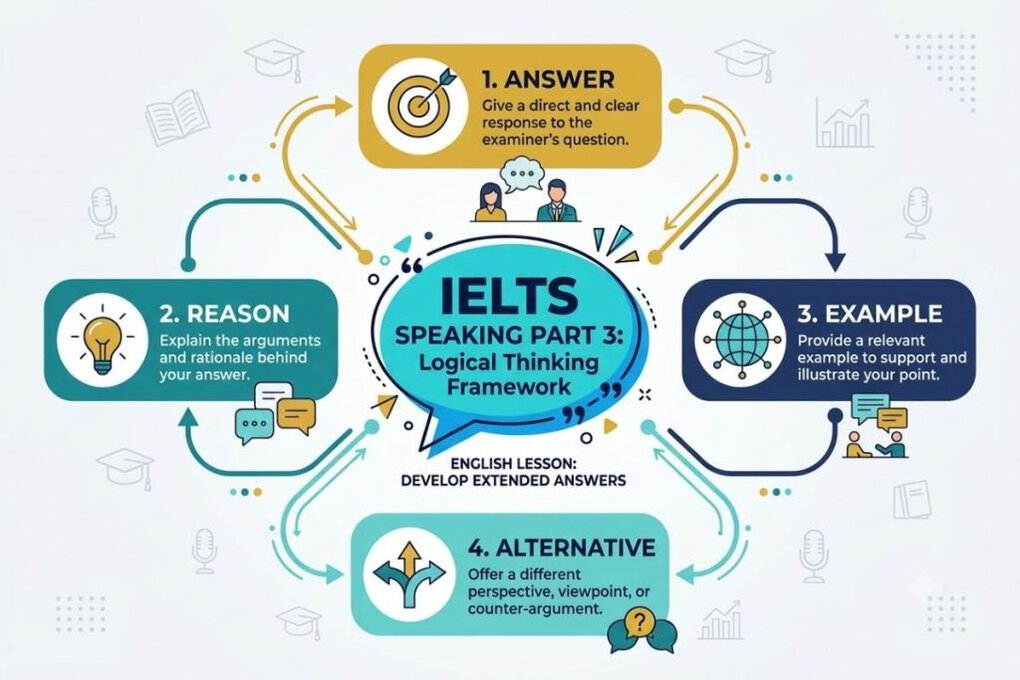
Many test-takers struggle because they do not know how to structure their thoughts on the spot. Using a reliable framework can help you organize your ideas quickly and thoroughly. The A.R.E.A framework is a highly effective tool for structuring your responses.
The A.R.E.A framework
- A – Answer: Begin by addressing the question directly. Do not talk around the issue. Give a clear statement of your opinion or observation.
- R – Reason: Explain the “why” behind your answer. This expands your response and shows the examiner your ability to articulate underlying causes.
- E – Example: Provide a broader, societal example. A major rule in ielts speaking part 3 is to avoid personal stories. Instead of saying, “My uncle bought an electric car,” say, “Many consumers in urban areas are transitioning to electric vehicles…”
- A – Alternative (Optional but effective): Briefly acknowledge an opposing viewpoint or a different perspective. This demonstrates critical thinking and adds depth to your language. For instance, “While some argue this is beneficial, others might point out the potential drawbacks”.
Handling difficult questions with natural fillers
Sometimes, an ielts speaking question will catch you off guard. It is completely acceptable to pause and think, provided you use natural language to buy time. Phrases like, “That is a fairly complex issue, but I tend to believe…” or “I haven’t thought about that extensively, but my initial reaction is…” are excellent ways to maintain your fluency score while you gather your thoughts.
High-frequency ielts speaking part 3 topics
While the exact questions change frequently, the broader themes remain relatively consistent. Familiarizing yourself with prominent ielts speaking part 3 topics allows you to build a versatile vocabulary bank.
Technology and society
Questions often revolve around how technology impacts human interaction, employment, and privacy. You might be asked to discuss the reliance on artificial intelligence or the effects of social media on community cohesion.
Environment and sustainability
Examiners frequently ask about who bears the responsibility for environmental protection—individuals, corporations, or governments. Discussions may also cover sustainable development, changing weather patterns, and the impact of consumerism on the planet.
Work-life balance
As workplace dynamics continue to evolve in 2026, questions regarding remote work, the gig economy, and the balance between professional ambitions and personal well-being are common ielts speaking part 3 topics.
Media and culture
You may need to evaluate how news is consumed, the influence of celebrities on youth, or how globalization affects local traditions and cultural identities.
Deep dive: IELTS speaking part 3 education
Education is a foundational theme in the IELTS exam. Because it affects every society, ielts speaking part 3 education questions are highly prevalent. You might be asked to compare past and present teaching methods or to evaluate the purpose of universities.
Topic significance
The IELTS test aims to gauge your readiness for academic and professional environments. Therefore, discussing education allows examiners to see if you possess the vocabulary and analytical skills necessary for higher-level discourse.
- “How has the role of a teacher evolved with the rise of digital learning?”
- “Do you think that higher education should be funded completely by the government?”
- “What are the advantages of continuous learning in today’s workforce?”
Valuable vocabulary for education
To elevate your response, consider integrating terms such as:
- Rote learning: Memorization based on repetition.
- Pedagogical shifts: Changes in teaching methods.
- Holistic development: Educating the whole person, including social and emotional skills.
- Egalitarian access: Equal opportunity to receive an education.
- Curriculum design: The structure and content of academic courses.
Worked example using the A.R.E.A framework
Let us look at how to answer an ielts speaking question on education.
Question: “Do you think practical skills should be prioritized over theoretical knowledge in high schools?”
Answer: “I believe that a balanced approach is generally more beneficial, though there is a strong argument for integrating more practical skills into the curriculum.” Reason: “Theoretical knowledge provides a necessary foundation for critical thinking, but practical skills are often what students need to navigate the real world and secure employment.” Example: “For instance, teaching financial literacy or basic programming alongside traditional subjects like history can equip students with tools they will use daily.” Alternative: “On the other hand, focusing entirely on practical skills might limit a student’s ability to engage with abstract concepts, which is why a hybrid approach seems most logical”.
Common pitfalls that can lower your score
Even with good vocabulary, candidates can lose marks if they do not understand the format of ielts speaking part 3. Here are a few habits to avoid:
- Relying on personal anecdotes As mentioned earlier, Part 3 is an abstract discussion. If you are asked about public transportation, avoid telling a long story about your morning commute. Instead, discuss infrastructure, government spending, or urban congestion.
- Providing overly brief answers Answering with a single sentence limits your ability to demonstrate your language range. Always aim to expand your thoughts using the reasons and examples outlined in the A.R.E.A framework.
- Remaining completely silent If you do not understand a word, do not sit in silence. It is much better to interact with the examiner. You can politely ask for clarification by saying, “Could you please rephrase that?” or “Just to clarify, do you mean…?” This shows communicative competence.
Frequently asked questions
How long does ielts speaking part 3 usually last?
This final section typically lasts between 4 to 5 minutes. The examiner will usually ask you 4 to 6 questions depending on the length and depth of your responses.
Will I lose points if I ask the examiner to explain a word?
Asking for clarification on a specific term does not automatically reduce your score. It is a natural part of conversation. However, asking for help on every question may indicate a limited vocabulary, which could affect your Lexical Resource score.
Does my opinion need to be factually accurate to score well?
The IELTS speaking test evaluates your language proficiency, not your general knowledge. Your arguments do not need to be rigorously fact-checked, as long as you can articulate and defend your viewpoints logically and coherently in English.
Key words:
- Ielts speaking part 3 sports
- Ielts speaking part 3 sample answers
- Ielts speaking part 3 sample
- Ielts speaking part 3 technology
- Ielts speaking part 3 topic
- Technology ielts speaking part 3
